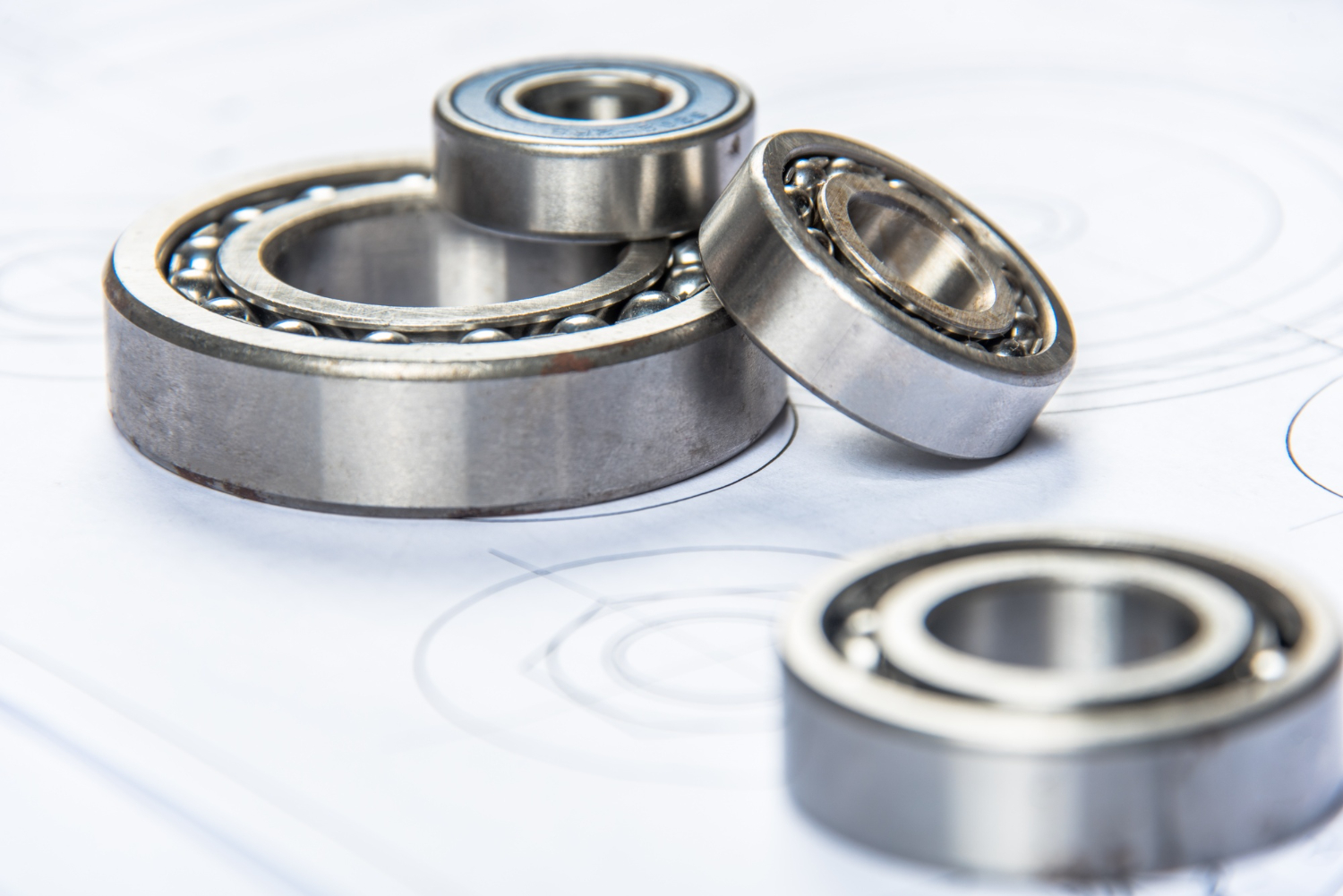
When selecting the most suitable material for ball bearings, it is essential to evaluate the specific operating conditions of each application. Different environments demand distinct mechanical, thermal, and chemical properties, and an improper material choice may compromise both efficiency and service life.
Bearing Materials: Selection Criteria, Properties, and Operational Influence
When selecting the most suitable material for ball bearings, it is essential to evaluate the specific operating conditions of each application.
Different environments demand distinct mechanical, thermal, and chemical properties, and an improper material choice may compromise both efficiency and service life.
Key determining factors include:
- Temperature, since materials have varying thermal tolerances;
- Environmental exposure, which can demand corrosion or wear resistance;
- Applied load, which influences deformation and load-bearing capacity;
- Rotational speed, as specific materials perform better at high or low RPMs.
A careful assessment of these factors ensures a precise material selection, resulting in maximum efficiency and extended bearing lifespan.
Chrome Steel – The Industrial Standard
Among the various materials used in bearing manufacturing, chrome steel (AISI 52100) stands out as the industry benchmark for its exceptional wear and fatigue resistance.
This alloy provides outstanding structural integrity and long-term performance, even under extreme stress conditions. Its surface hardness and ability to resist abrasion make it ideal for demanding applications in heavy-duty machinery and high-speed systems.
Performance and Mechanical Strength
Chrome steel not only resists wear but also demonstrates impressive load-bearing capacity and high-speed stability.
It is widely employed in heavy machinery, where bearings are subjected to intense and continuous loads, as well as in precision components requiring reliability under high rotational speeds.
Use in High-Precision Bearings
Due to its uniform hardness, dimensional stability, and low friction coefficient, chrome steel is a preferred material for high-precision bearings.
It is commonly used in machine tools, robotics, and aerospace systems, where tight tolerances and smooth rotation are essential for achieving consistent accuracy and reliability.
By selecting chrome steel, engineers ensure both durability and mechanical efficiency, making it a proven choice for applications requiring strength, precision, and longevity.
Stainless Steel – Corrosion Resistance and High-Temperature Stability
Stainless steel is widely recognized for its excellent corrosion resistance, making it ideal for applications exposed to moisture, chemicals, or saline environments.
The presence of chromium in its composition forms a passive chromium oxide layer, which prevents structural degradation caused by oxidation or chemical exposure.
Resistance to Corrosion and Heat
Beyond corrosion resistance, stainless steel offers strong thermal stability, maintaining mechanical integrity even under elevated temperatures.
This makes it well-suited for environments where temperature variations are significant or where heat dissipation is critical to system reliability.
Applications in Food, Pharmaceutical, and Medical Equipment
Stainless steel bearings are frequently used in food processing and medical industries, where hygiene and contamination prevention are essential.
Its ability to resist rust, tolerate frequent washdowns, and withstand aggressive cleaning solutions ensures long-term reliability in sterile or regulated environments.
By combining corrosion resistance with high-temperature performance, stainless steel remains a versatile and dependable material choice for a wide range of industrial and hygienic applications.
Ceramic Bearings – For High-Performance Applications
Ceramic bearings represent the forefront of high-performance materials, offering a unique combination of low friction, high hardness, and exceptional wear resistance.
They are particularly advantageous in demanding environments where precision, stability, and speed are paramount.
Exceptional Wear and Corrosion Resistance
Ceramic materials, such as silicon nitride (Si₃N₄) or zirconia (ZrO₂), exhibit superior resistance to chemical attack and corrosion.
They are ideal for use in chemical plants, vacuum systems, and marine environments.
Furthermore, ceramics act as electrical insulators, expanding their use to applications where electrical conductivity poses a risk.
High-Speed and Extreme Conditions
Ceramic bearings perform exceptionally well in high-speed and extreme temperature environments.
Their low density reduces centrifugal forces, allowing for smoother, quieter operation at high RPMs while maintaining structural integrity.
This makes them a preferred choice in aerospace, precision motors, and semiconductor industries.
When operational performance under extreme conditions is required, ceramic bearings provide unmatched durability and efficiency, even in the harshest industrial settings.
Hybrid Bearings – Combining the Best of Both Worlds
Hybrid bearings combine ceramic rolling elements with steel races, creating a balanced solution that leverages the strengths of both materials.
This combination results in components that are lightweight, durable, and thermally efficient, making them ideal for high-speed, high-precision applications.
Material Synergy: Ceramics and Steel
In hybrid configurations, ceramic balls provide low friction and wear resistance, while steel races ensure structural strength and load capacity.
The reduced mass of ceramic elements also leads to lower vibration and operating temperatures, improving system longevity and energy efficiency.
Durability and Energy Efficiency
Hybrid bearings exhibit extended service life due to minimal wear and lower lubrication requirements.
Their design reduces heat buildup, enabling longer operation cycles and lower maintenance frequency.
Typical Industrial Applications
These bearings are increasingly used in automotive engineering, electric motors, and turbocompressors, where reliability, speed, and energy efficiency are critical.
Their ability to operate quietly and efficiently under demanding conditions makes them an optimal choice for modern industrial systems.
In summary, hybrid bearings offer superior durability and performance, merging the mechanical robustness of steel with the friction-reducing properties of ceramics.
Operational Conditions Influencing Material Selection
Temperature and Thermal Resistance
Temperature variations significantly affect bearing performance.
Materials such as chrome steel, stainless steel, and advanced ceramics are engineered to withstand specific temperature ranges.
Ceramic bearings, in particular, are ideal for high-temperature applications, as they maintain dimensional stability and strength under thermal stress.
Proper selection mitigates issues such as thermal expansion, which could otherwise compromise bearing alignment and performance.
Load and Speed Factors
The applied load directly influences the required material properties.
High-load applications benefit from hardened steels with high compressive strength, while high-speed systems require materials with low friction coefficients and reduced inertia, such as ceramics or lightweight alloys.
Balancing load and speed considerations ensures safe, efficient, and long-lasting bearing operation.
Environmental Considerations
Environmental exposure—such as humidity, dust, or corrosive agents—plays a decisive role in material selection.
In corrosive settings, stainless steel or coated bearings provide enhanced protection.
For abrasive conditions, materials with superior wear resistance are recommended to prevent premature surface degradation.
Accurate assessment of environmental conditions guarantees optimal bearing reliability even under challenging circumstances.
Conclusion
Bearings are critical components in countless mechanical systems, and the choice of material directly impacts performance, efficiency, and lifespan.
- Chrome steel remains the industry standard for heavy loads and high-speed applications.
- Stainless steel excels in corrosive and high-temperature environments.
- Ceramic materials offer unmatched advantages for lightweight, high-speed, and extreme conditions.
- Hybrid bearings combine the strengths of both, delivering optimized energy efficiency and extended durability.
Selecting the right bearing material requires a comprehensive understanding of operating temperature, environmental conditions, applied load, and rotational speed.
Through detailed analysis and informed decision-making, engineers can ensure maximum performance, reduced maintenance costs, and superior reliability across all industrial applications.
Leave a Reply